The Redesign Method: Lasting Change Requires Us to Look Within and Around Us
At The Redesign Institute, we work at the intersection of both because lasting change requires us to understand what is happening within people and what is happening around them.
Psychology has traditionally focused on changing the individual.
Organizational consulting tends to focus on changing the organization.
At The Redesign Institute, we work at the intersection of both because lasting change requires us to understand what is happening within people and what is happening around them.
Neither perspective is complete on its own.
People shape environments, and environments shape people
The environments around us influence how we think, feel, behave, connect, and perform. A workplace with clear priorities and trustworthy leadership can help people focus and take thoughtful risks. A workplace marked by conflicting demands, unpredictable decisions, or chronic urgency can keep people guarded and reactive.
At the same time, environments are not abstract forces. They are created and reinforced every day through human choices. Leaders decide what gets rewarded. Teams establish norms around communication. Employees interpret policies and respond to one another. People bring their histories, strengths, fears, habits, and expectations into every relationship and every decision.
This reciprocal influence explains why change efforts so often stall.
An organization may introduce a new process without attending to the trust, skills, or beliefs people need to use it. An individual may learn better boundaries but remain in an environment where every boundary carries a professional cost. A leader may attend a workshop on psychological safety while the organization continues rewarding speed, certainty, and agreement.
The initiative may be technically sound, yet the larger design keeps pulling people back toward familiar outcomes.
Repeated outcomes are information
When we encounter burnout, disengagement, conflict, turnover, stalled growth, or chronic underperformance, it is tempting to search for the person or problem at fault.
Who is not resilient enough? Which manager is failing? What employee has a bad attitude? Which department refuses to cooperate?
Accountability matters, but blame narrows our field of vision. It encourages quick explanations before we understand what is actually creating the outcome.
The Redesign Method starts with a better question:
What needs to be redesigned?
That question does not excuse harmful behavior or erase personal responsibility. It gives us a more useful way to investigate it. It asks what patterns, conditions, relationships, expectations, beliefs, resources, and structures are shaping what we see.
If several capable employees have struggled in the same role, the role itself deserves examination. If a leader repeatedly avoids difficult conversations, we may need to explore both the leader’s internal response to conflict and the organizational culture surrounding disagreement. If a professional cannot create space for rest despite understanding its importance, we should examine personal beliefs about worth alongside the practical design of their workload and home life.
The outcome is not the whole story. It is the invitation to look more closely.
An iterative approach to meaningful change
The Redesign Method is a psychology-informed, data-guided approach to change. It is not a single formula applied to every challenge. Individuals and organizations require different tools, but both need a process for understanding what is happening, making intentional choices, taking action, and learning from what follows.
For organizations, the method moves through four interconnected stages:
Analysis
We begin by understanding the current design. We examine outcomes, experiences, behaviors, relationships, processes, resources, and structures. Quantitative and qualitative data help us identify patterns and distinguish a visible symptom from the conditions producing it.
Alignment
Next, we clarify what matters. What is the organization trying to accomplish? What values should guide the work? Where do current practices support those priorities, and where do they compete with them? Alignment turns broad aspirations into design criteria for decision-making.
Action
Insight alone does not create change. In this stage, we translate what we have learned into practical interventions. That might involve leadership development, workload redesign, clearer decision rights, new feedback practices, process changes, team learning, or a different approach to accountability.
Adaptation
No design is perfect on the first attempt. We observe what happens, gather feedback, examine new outcomes, and adjust. Adaptation makes change responsive rather than rigid and builds the organization’s ability to keep learning after a formal initiative ends.
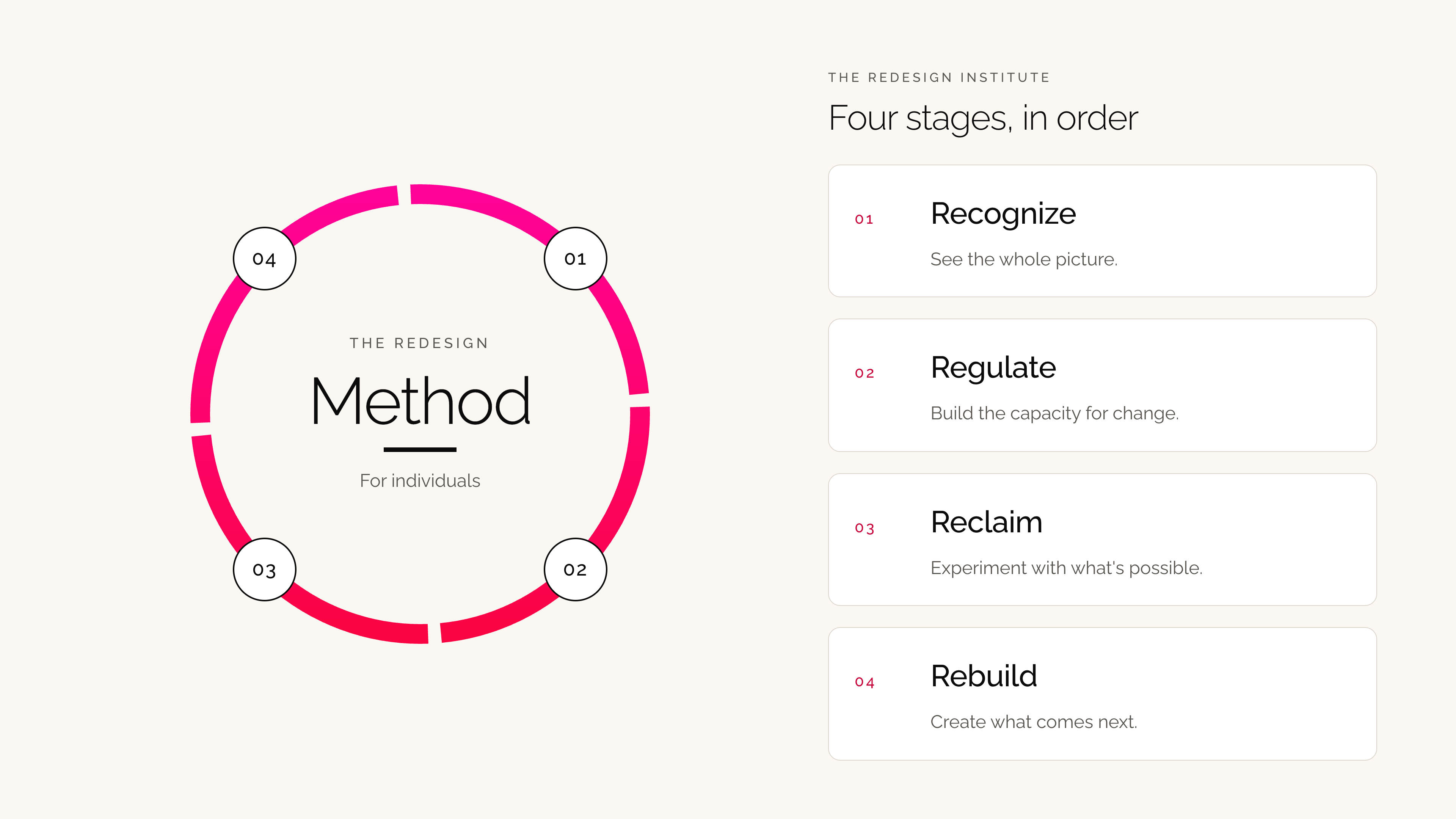
For individuals, the process also has four stages:
Recognize
We step back and see the whole picture. What is working? What is not? What patterns keep repeating? What has changed in your life, values, needs, or identity? Recognition creates an honest starting point and a clear redesign plan.
Regulate
Change is difficult when the nervous system is overwhelmed. This stage focuses on the skills and support needed to manage stress, tolerate uncertainty, understand emotional responses, and move from reaction toward choice.
Reclaim
We identify what has been lost, suppressed, or never fully held. That might include voice, agency, confidence, time, creativity, connection, or a sense of possibility. Reclaiming allows a person to make choices from a more grounded and authentic place.
Rebuild
Finally, we create and test a design that better fits. New routines, boundaries, relationships, roles, or goals become part of daily life. We learn from what works, revise what does not, and build the capacity to adapt as life continues to change.
Different challenges, connected truths
Organizations are not simply machines made of processes. They are human environments. Individuals are not isolated from the conditions in which they live and work.
That is why lasting change cannot be reduced to fixing people or rearranging structures. We need to understand the relationship between the two.
Sometimes a person needs new skills. Sometimes a workplace needs a new practice. Often, both need to change in coordinated ways.
The Redesign Method helps us move beyond surface solutions and false choices. It gives us a disciplined way to ask better questions, look at the whole, act with intention, and adapt based on what we learn.
Because when the way we live and work is not working, it is time for a redesign.